Showing posts with label weapons. Show all posts

Thursday, February 9, 2012

SHTF Fashion and Style....(yeah, I went there)

Fashion and style are greatly overlooked in most peoples preps. While that statement sounds idiotic it has some mettle. You need to decide what your bug out look will be. There are two basic looks that won't get you mugged and stripped of your preps. You can go with the "blend in" approach and wear simple street clothes with a standard backpack as your bug out bag. The other option is to look like a smooth operator straight out of a movie or video game. It is hard to argue which option is better as both have pros and cons.

First, lets examine the street clothes option. Blending in is usually a great plan. The less attention you receive the more likely you are to go unnoticed. Those that blend in will not look like they have too much to take if they are noticed by some in-prepared vultures of men. The backpack will be a dead giveaway for those carrying one if it is too flashy. A giant hikers pack says "I have a lot of stuff that you need to survive. Come take it." The tactical option says "I have a lot of stuff that you need to survive. Come any try to take it; you probably can't. Pick the next guy."


If you go for the tactical operator look you will definitely be more equipped to carry more bug out equipment.  You will also be telling everyone around you that you have the supplies that they need. On the other hand, if your have on a pair of combat boots and an assault rifle across your chest strapped to a tactical vest people are far less likely to cross you.

Of course these aren't the only two options but they are the best two in my opinion. For my situation I like the tactical look. Two of my preferred bug out routes will surely lead me through a highly populated area and I like to look more like a wolf than a sheep. Hopefully my bug out will happen before panic sets in though,if it happens at all. Nothing says don't mess with me more than a black AR hanging across your chest, a machete sticking up from behind your backpack and a sidearm.


Sunday, January 29, 2012

EoTech has a new sight tailor made for zombie slaying!

I stumbled on this awesome edition of the unstoppable EoTech holographic sight. They are calling it the XPS2 Zombie stopper. It packs all of the standard features of the Eotech XPS like:

  • Single transverse 123 battery to reduce sight length
  • Shortened base only requires at most 2 3/4 inch of rail space
  • Battery cap is a simple O-ring, tethered cap that offers a better seal
  • Average battery life at brightness level 12 is roughly 600 hours
It also has a killer recticle! It is a 65 MOA ring with a 1 MOA dot in the center. The kicker are the tails coming off of the ring. It looks like a bio-hazard symbol.
Of course the tails add no function. They just make a cool sight even cooler! According to the EoTech website this edition of the XPS2 will be available in April of 2012. I found this video from SHOT Show. Check it out! ( It's just below) I have to give EoTech two thumbs up for this one. A top notch holographic sight with a biohazard recticle is just too cool. The insignia printed on the outside of of the sight isn't too shabby either.

If you are not familiar with EoTech they are worth checking out. I am not going to spew out all of the technical information because every other gun blogger on the internet has already done so. I just want to say that EoTech's are nearly indestructible and add an almost video game feel to putting precious metal down range. They make target acquisition nearly instant and effortless. Now that is exactly what we need when facing a horde of brain eaters!

This post has given me another idea. I am going to add an ultimate zombie AR page to the blog. I will scour the intrnet and provide you, the readers, with zombie themed and components. It will essentially be a list of what you need to build the ultimate zombie slaying AR15. Don't worry, function will surpass aesthetics in the components I list.

Visit the product page on EoTech's site for all of the technical details by clicking HERE.

Sunday, August 21, 2011

Sunday, August 14, 2011

WEAPONS: Improvised weapons

Your ammo cans have ran dry, the grenades have all been cooked, and the arrows have all splintered inside of some zed's head. What do you do now? That is when you get creative. Rather they be a horde of zombies during the outbreak or a group of looters after a violent storm there is always potential for you to be victimized after any type of disaster. A survivor must be able to protect themselves even after your supplies are depleted. When the stockpiles are looking low is when the strong will attack. Don't be a victim. Make you own weapons. What is a weapon?

weap·on/ˈwepən/Noun

1. A thing designed or used for inflicting bodily harm or physical damage.
2. A means of gaining an advantage or defending oneself in a conflict or contest: "resignation threats are a weapon in his armory"


It seemed like a good idea at first.
Some examples of improvised weapons are sporting equipment such as baseball bats and golf clubs. Tools like pipe wrenches, shovels, axes and more work great as well. There are plenty of items just laying around that one could use as a weapon. The trick is improving the weapons you have found with some slight modifications. Squaring off a baseball bat will give it four very effective edges. Cutting a pipe of at an angle makes it an edged weapon too. Since this post is just touching on the topic of improvised weapons I encourage you to use the comment box at the bottom of the post to tell us your ideas for improvised weapons. This is the first post of a series. I am going to start posting about making improvised weapons on a regular basis. Make sure you hit that SUBSCRIBE button at the top of the page so that you will know when those posts are ready.


Sunday, July 17, 2011

WEAPONS: Handguns

Handguns are an essential component in any armament. A side-arm is invaluable is close quarters and when the ammo in the long-gun runs out. It is important to keep in mind that a pistol is not a substitute for a rifle in a battle situation. The average person that owns a pistol, has zero training, and only makes it to the range two to three times a year is not going to be very effective under the stresses of battle.

There are hundreds of options  when it comes to choosing what type of pistol if for you. I see no purpose other than nostalgia for something like a Desert Eagle .50AE. Many prefer .45 ACP over all other calibers but I am a 9mm guy. Most modern calibers a highly effective against human sized targets. I am also a fan of polymer guns. My carry pistol is a 4" Springfield XD9. I have owned Glock's and revolvers. I have shot Sig's, 1911's, a USP, and plenty more hand gun variants but really took to my XD. Finding which gun is right for you is very important. Make sure magazines are readily available for your selection. It is also a good idea to shell out the extra cash for premium mags. A $2000 custom 1911 is worthless without quality mags to run it with. Bad mags cause jams and miss feeds.

The single most important thing about hand guns is to actually have one. After that, the next most important thing is training. Take a course. Go to the range often. You don't need to become a SEAL Team 6 caliber shooter. You must need to be proficient with YOUR firearm.

That is all for handguns FOR NOW, expect lots more as I can write and talk about guns all day :)


Sunday, June 19, 2011

Ultimate Zombie Gun - The Case for the Remington 870

by Will Dabbs in the December 2010 issue of SWAT Magazine

There you are, out washing the car on a beautiful sunny afternoon.
Above the noise of the kids playing and the wife humming to herself as she prunes her roses, you detect an unnatural, unfamiliar and eerie sound. Looking up from your Turtle Wax, you peer over the hood of the car and spot a veritable army of the undead staggering up your driveway.
Instantly you shout the alarm and your family leaps into action. Your son grabs a case of MREs and heads for the minivan. Your daughter scoops up as much bottled water as she can carry and rushes to meet him. Your wife bravely holds the horde at bay with the garden hose to buy you precious time to get inside. You throw open the door to the gun safe and scan its contents. You have very little time. You can only grab one gun and a sack full of ammo. What's it going to be? There's a lot riding on your decision—those guys outside want to eat your brain...
So what will it be? The argument of what gun to have if you could only have one sparks lively discourse any place two or more gun guys are gathered.
As my long-suffering bride can attest, we gun guys have a bit of a problem with the concept of how much is really enough. Even zealots with hundreds of guns of all flavors are still out there hunting that last elusive barrel length or nitnoid widget without which their collection remains woefully incomplete. The discussion of what comes closest to filling the niche for a single all-purpose survival firearm can indeed be spicy.
Some say a single survival gun should be an AR-15 for its light weight, wealth of accessories and fast handling. Others stand by the venerable Kalashnikov for its legendary reliability. Still others swear that as long as you have a tuned 1911 in your belt, you could want for nothing else.
I disagree with all those folks. I say the ultimate zombie survival gun is some variation on your granddad's pump 12 gauge.
MAXIMUM VERSATILITY
Art
It's hard to beat a 12 bore for flexibility and versatility. Stuff it with slugs and you're good on zombie-sized targets out to 100 meters. Feed it buckshot and you've got more up-close stopping power than anything that doesn't sport a tripod or an impact fuse. Switch to light birdshot and you can even feed the family during your trek to areas not contaminated with the undead.
I've owned scads of shotguns but always seem to come back to my trusty Remington 870 slide-action when the new wears off of whatever whiz-bang scattergun has caught my eye. Around my hacienda, the 870 stands out among all the other weapons in the collection, and my family refers to it as the Zombie Gun.
The 870 has been around since 1950 and thus sports an array of aftermarket accessories that can induce overload in even the most ardent gun nut. The action is notoriously reliable and smooth and, even bought new, this workhorse doesn't make the dent in your wallet that most contemporary black guns do.
EXERCISING YOUR STOCK OPTIONS
Swapping the stock out on an 870 requires either a standard screwdriver or a hex wrench and takes less time than is required to describe it.
A bare pistol grip configures the weapon such that it can actually be concealed under a jacket—a handy feature when traversing areas not completely overrun with zombies—but the recoil and accuracy in this configuration with even light birdshot are punishing.
The standard stock that comes with the gun is appropriately scaled for most American shooters and, if so configured, does not raise eyebrows when carried in public or hung in the back of a pickup truck—at least not down here in the Deep South where I live.
Folding stocks come in a wide variety of offerings but are, in my experience, universally uncomfortable. I have found the Speedfeed® pistolgrip stock to be the most comfortable and handy stock option of the lot.
What sets the Speedfeed stock apart from its competitors is the clever inclusion of a pair of spare ammo magazines in the sides of the stock. Each tubular magazine is spring-loaded and holds two spare rounds. Accessing these reloads is simple and intuitive and allows four rounds of backup ammo to be stored onboard the weapon itself without adversely affecting the weapon's ergonomics or adding some protruding ditzel that could get hung up on clothing, equipment, or brush.
The pistol-grip geometry of the Speedfeed stock fits me nicely and helps ameliorate the recoil of high brass slugs and buckshot that might otherwise punish my shoulder unduly. This stock comes complete from the factory with a generous rubber recoil pad.
BARREL LENGTH AND APPLICATIONS
My particular 870 came from the factory with a 28-inch vent rib tube. While that might be dandy for a day of popping birds or skeet, something stubbier is needed if you are to be fighting your way through mobs of brain-eating ghouls. I picked up a used 18-inch tube at a gun shop years ago for practically nothing and did a BATF Form One to cut the barrel down to something that would be a bit more maneuverable.
Art
While this process may seem somewhat daunting, there really isn't much to it. The form is available online and must be submitted in duplicate along with a recent photograph, a set of standard FBI fingerprint cards, a check for $200, and the signature of your local chief law enforcement official. The turnaround time can be fairly quick, but they say patience is a virtue. This particular set of paperwork took about three months door to door.
Once the paperwork returns approved from BATF, taking the barrel down is a fairly painless task. I cut the barrel to length with a cutoff wheel on a table saw and dressed the muzzle with a Dremel tool. My drill press and an appropriate tap mounted one of those nifty neon-green aftermarket front sights at the appropriate position.
The purist could have the muzzle bored for replaceable choke tubes. However, against snakes, varmints and the like, the 12-inch barrel as cut and squared has yielded yeoman's service for the 14 years I have been using it.
After degreasing the chopped barrel with paint thinner, I sprayed it with ceramic engine block paint and baked it according to the manufacturer's instructions. The resulting finish has been impervious to every solvent I've exposed it to, as well as mightily ding and scuff-resistant.
A homebuilt sling system optimized for my physique completes the ensemble and makes toting the piece on long forays comfortable and manageable. In my experience, it's worth it to invest a little time, effort and money into a quality suspension system for any weapon that will be keeping you company on long walks or cross-country movement. Even small, compact firearms become an uncomfortable nuisance after a couple of miles without a decent sling or holster.
PUTTING THE ZOMBIE GUN THROUGH ITS PACES
While more conventionally minded gun enthusiasts have publicly maligned me for carrying a shotgun with a 12-inch tube, I might observe that this is still more than twice the barrel length of a typical handgun with the commensurate more-than-adequate sight radius.
In the years I have been using my Zombie Gun, I have run just about every conceivable round through it. Buckshot and slugs are still a handful, but the Speedfeed stock makes the recoil tolerable. Through the 12-inch barrel, patterns with buckshot are still tight enough to scrape a zombie at any reasonable engagement range. As previously mentioned, rifled slugs will stay on a zombie-sized target out to about 100 meters.
Flechette rounds, less-than-lethal beanbag rounds, and magnesium-spewing dragon's breath rounds have all performed as advertised through this system as well.
With the long 28-inch tube and a full choke, the Zombie Gun does a fine job against turkey. With the right stock, ammunition and barrel selection, this piece is good on rabbits, squirrels, deer, and birds when the zombie threat is minimal. In my experience, there is very little that can be legally hunted in North America that cannot be reliably addressed with my Zombie Gun in the appropriate configuration.
COST TO BE ADEQUATELY PREPARED FOR A ZOMBIE ATTACK
If I were a newbie and wanted to lay the foundation for a decent working firearms collection, I would start with an 870 system. Substantially less than $1,000 would get the gun, a spare barrel, BATF approval to shorten same, more stocks and accessories than you could keep track of, a boatload of ammo, and still leave you enough money to lay in a little shelf-stable food and water.
Unlike ammo for machine guns or even semi-auto black rifles, a couple boxes of ammo for the 870 will actually carry you through an afternoon at the range without breaking the budget. If carefully selected, $20 to $30 will purchase enough ammo in the appropriate configurations to set aside for any realistic eventuality, as well as a few unrealistic ones. I can seriously say that I get more real-world use out of my utility zombie shotgun than any other weapon I own.
I suggest you not tell just anybody about your plans to acquire a Zombie Gun. Most gun nuts will think it a respectable undertaking and volunteer volumes of free advice as to technical specifications and capabilities. However, some will try to have you put away or, at the very least, relocate to a neighborhood far from yours.
But in the right company, the question of what is the perfect Zombie Gun can be relied upon to spark a spirited discussion.
Independent of the true practical applications of such a system, it makes sense to put a little thought into a survival plan and equipment in advance of an emergency. If 9/11 and Katrina have shown us anything, it is that even here in America we are not immune to crisis, disaster and civil unrest.
Whether your day job involves keeping the peace or just being a responsible citizen, the legal exercise of our Second Amendment rights represents the best safeguard we have for the remainder of the Bill of Rights.
It has been said that luck favors the prepared and, who knows, if you are the only adequately armed guy on your block, perhaps the zombie horde will move on to the house of that neighbor with the deep-seated aversion to firearms and the Handgun Control Inc. bumper sticker on his car.


Saturday, June 18, 2011

Why you must keep iron sights on your guns.

    Of all of my guns only one is without it's iron sights. My "Baby Barrett" is a Ruger 10/22 that has been modified to look like a mini .50 sniper rifle. Irons are crucuial unless your just want to hit someone with your stock. EoTechs and Aimpoints are phenomenal optics but there is one event that can render them completely useless. An EMP, or electromagnetic pulse, basically destroys all electronic devices and grids. Your fancy optic stands no chance against an EMP.
   Solar flares have been in the news a lot lately because of the giant one that passed over us a few weeks ago. It was the size of Jupiter but was minuscule compared to what the sun is capable of. Many experts believe that a much larger solar flare will hit Earth before the end of 2011. I am not going to go into much detail about EMP's and solar flares because I am assuming that if you are smart enough to be reading this blog than your are smart enough to use Google.
   The point I want to make is that everyone needs to make sure their primary firearms have iron sights on them. You also need to be proficient with your irons. I am not saying that we need to shoot up into the sky to try to wound the solar flare in such an event. I am just saying to be ready with the basics. A massive solar flare could keep you without electricity for 4 or more months. Can you imagine how desperate the unprepared will be after 4 months with no electricity? It could get ugly. Defend your family with iron sights. The bullets are just as effective coming from in front of them as they are from the best Aimpoint money can buy.

MORE INFO ON SOLAR FLARES
 

Saturday, June 11, 2011

AK-47 Field Manual

....long time no post.

I am behind of ZS blog posts because I am working on a multi-part article on the science behind the threat of a zombie outbreak. Anyways, here is a manual for the almighty AK-47. If you don't have an AK in your arsenal you should look into adding one! Enjoy...

AK47USArmyOperatorManual

Monday, April 18, 2011

Police Have No Duty To Protect Individuals

This is not my original work. I just feel that I am obligated to pass it on. Learn to defend yourselves people! I am a police supporter but I also understand that they cannot be everywhere at all times and the I must be able to defend my family and my home. Here is a link to where I found this 


Police Have No Duty To Protect Individuals

by Peter Kasler

Self-Reliance For Self-Defense -- Police Protection Isn't Enough!

All our lives, especially during our younger years, we hear that the police are there to protect us. From the very first kindergarten- class visit of "Officer Friendly" to the very last time we saw a police car - most of which have "To Protect and Serve" emblazoned on their doors - we're encouraged to give ourselves over to police protection. But it hasn't always been that way.
Before the mid-1800s, American and British citizens - even in large cities - were expected to protect themselves and each other. Indeed, they were legally required to pursue and attempt to apprehend criminals. The notion of a police force in those days was abhorrent in England and America, where liberals viewed it as a form of the dreaded "standing army."
England's first police force, in London, was not instituted until 1827. The first such forces in America followed in New York, Boston, and Philadelphia during the period between 1835 and 1845. They were established only to augment citizen self-protection. It was never intended that they act affirmatively, prior to or during criminal activity or violence against individual citizens. Their duty was to protect society as a whole by deterrence; i.e., by systematically patrolling, detecting and apprehending criminals after the occurrence of crimes. There was no thought of police displacing the citizens' right of self-protection. Nor could they, even if it were intended.
Professor Don B. Kates, Jr., eminent civil rights lawyer and criminologist, states:
    Even if all 500,000 American police officers were assigned to patrol, they could not protect 240 million citizens from upwards of 10 million criminals who enjoy the luxury of deciding when and where to strike. But we have nothing like 500,000 patrol officers; to determine how many police are actually available for any one shift, we must divide the 500,000 by four (three shifts per day, plus officers who have days off, are on sick leave, etc.). The resulting number must be cut in half to account for officers assigned to investigations, juvenile, records, laboratory, traffic, etc., rather than patrol. [1]
Such facts are underscored by the practical reality of today's society. Police and Sheriff's departments are feeling the financial exigencies of our times, and that translates directly to a reduction of services, e.g., even less protection. For example, one moderate day recently (September 23, 1991) the San Francisco Police Department "dropped" [2] 157 calls to its 911 facility, and about 1,000 calls to its general telephone number (415-553-0123). An SFPD dispatcher said that 150 dropped 911 calls, and 1,000 dropped general number calls, are about average on any given day. [3]
It is, therefore, a fact of law and of practical necessity that individuals are responsible for their own personal safety, and that of their loved ones. Police protection must be recognized for what it is: only an auxiliary general deterrent.
Because the police have no general duty to protect individuals, judicial remedies are not available for their failure to protect. In other words, if someone is injured because they expected but did not receive police protection, they cannot recover damages by suing (except in very special cases, explained below). Despite a long history of such failed attempts, however, many, people persist in believing the police are obligated to protect them, attempt to recover when no protection was forthcoming, and are emotionally demoralized when the recovery fails. Legal annals abound with such cases.
Warren v. District of Columbia is one of the leading cases of this type. Two women were upstairs in a townhouse when they heard their roommate, a third woman, being attacked downstairs by intruders. They phoned the police several times and were assured that officers were on the way. After about 30 minutes, when their roommate's screams had stopped, they assumed the police had finally arrived. When the two women went downstairs they saw that in fact the police never came, but the intruders were still there. As the Warren court graphically states in the opinion: "For the next fourteen hours the women were held captive, raped, robbed, beaten, forced to commit sexual acts upon each other, and made to submit to the sexual demands of their attackers."
The three women sued the District of Columbia for failing to protect them, but D.C.'s highest court exonerated the District and its police, saying that it is a "fundamental principle of American law that a government and its agents are under no general duty to provide public services, such as police protection, to any individual citizen." [4] There are many similar cases with results to the same effect. [5]
In the Warren case the injured parties sued the District of Columbia under its own laws for failing to protect them. Most often such cases are brought in state (or, in the case of Warren, D.C.) courts for violation of state statutes, because federal law pertaining to these matters is even more onerous. But when someone does sue under federal law, it is nearly always for violation of 42 U.S.C. 1983 (often inaccurately referred to as "the civil rights act"). Section 1983 claims are brought against government officials for allegedly violating the injured parties' federal statutory or Constitutional rights.
The seminal case establishing the general rule that police have no duty under federal law to protect citizens is DeShaney v. Winnebago County Department of Social Services. [6] Frequently these cases are based on an alleged "special relationship" between the injured party and the police. In DeShaney the injured party was a boy who was beaten and permanently injured by his father. He claimed a special relationship existed because local officials knew he was being abused, indeed they had "specifically proclaimed by word and deed [their] intention to protect him against that danger," [7] but failed to remove him from his father's custody.
The Court in DeShaney held that no duty arose because of a "special relationship," concluding that Constitutional duties of care and protection only exist as to certain individuals, such as incarcerated prisoners, involuntarily committed mental patients and others restrained against their will and therefore unable to protect themselves. "The affirmative duty to protect arises not from the State's knowledge of the individual's predicament or from its expressions of intent to help him, but from the limitation which it has imposed on his freedom to act on his own behalf." [8]
About a year later, the United States Court of Appeals interpreted DeShaney in the California case of Balistreri v. Pacifica Police Department. [9] Ms. Balistreri, beaten and harassed by her estranged husband, alleged a "special relationship" existed between her and the Pacifica Police Department, to wit, they were duty-bound to protect her because there was a restraining order against her husband. The Court of Appeals, however, concluded that DeShaney limited the circumstances that would give rise to a "special relationship" to instances of custody. Because no such custody existed in Balistreri, the Pacifica Police had no duty to protect her, so when they failed to do so and she was injured they were not liable. A citizen injured because the police failed to protect her can only sue the State or local government in federal court if one of their officials violated a federal statutory or Constitutional right, and can only win such a suit if a "special relationship" can be shown to have existed, which DeShaney and its progeny make it very difficult to do. Moreover, Zinermon v. Burch [10] very likely precludes Section 1983 liability for police agencies in these types of cases if there is a potential remedy via a State tort action.
Many states, however, have specifically precluded such claims, barring lawsuits against State or local officials for failure to protect, by enacting statutes such as California's Government Code, Sections 821, 845, and 846 which state, in part: "Neither a public entity or a public employee [may be sued] for failure to provide adequate police protection or service, failure to prevent the commission of crimes and failure to apprehend criminals."
It is painfully clear that the police cannot be relied upon to protect us. Thus far we've seen that they have no duty to do so. And we've also seen that even if they did have a duty to protect us, practically- speaking they could not fulfill it with sufficient certainty that we would want to bet our lives on it.
Now it's time to take off the gloves, so to speak, and get down to reality. So the police aren't duty-bound to protect us, and they can't be expected to protect us even if they want to. Does that mean that they won't protect us if they have the opportunity?
One of the leading cases on this point dates way back into the 1950s. [11] A certain Ms. Riss was being harassed by a former boyfriend, in a familiar pattern of increasingly violent threats. She went to the police for help many times, but was always rebuffed. Desperate because she could not get police protection, she applied for a gun permit, but was refused that as well. On the eve of her engagement party she and her mother went to the police one last time pleading for protection against what they were certain was a serious and dangerous threat. And one last time the police refused. As she was leaving the party, her former boyfriend threw acid in her face, blinding and permanently disfiguring her.
Her case against the City of New York for failing to protect her was, not surprisingly, unsuccessful. The lone dissenting justice of New York's high court wrote in his opinion: "What makes the City's position [denying any obligation to protect the woman] particularly difficult to understand is that, in conformity to the dictates of the law [she] did not carry any weapon for self-defense. Thus, by a rather bitter irony she was required to rely for protection on the City of New York which now denies all responsibility to her." [12]
Instances of police refusing to protect someone in grave danger, who is urgently requesting help, are becoming disturbingly more common. In 1988, Lisa Bianco's violently abusive husband was finally in jail for beating and kidnapping her, after having victimized her for years. Ms. Bianco was somewhat comforted by the facts that he was supposedly serving a seven-year sentence, and she had been promised by the authorities that she'd be notified well in advance of his release. Nevertheless, after being in only a short time, he was temporarily released on an eight-hour pass, and she wasn't notified. He went directly to her house and, in front of their 6- and 10- year old daughters, beat Lisa Bianco to death.
In 1989, in a suburb of Los Angeles, Maria Navarro called the L. A. County Sheriff's 911 emergency line asking for help. It was her birthday and there was a party at her house, but her estranged husband, against whom she had had a restraining order, said he was coming over to kill her. She believed him, but got no sympathy from the 911 dispatcher, who said: "What do you want us to do lady, send a car to sit outside your house?" Less than half an hour after Maria hung up in frustration, one of her guests called the same 911 line and informed the dispatcher that the husband was there and had already killed Maria and one other guest. Before the cops arrived, he had killed another.
But certainly no cop would stand by and do nothing while someone was being violently victimized. Or would they? In Freeman v. Ferguson [13] a police chief directed his officers not to enforce a restraining order against a woman's estranged husband because the man was a friend of the chief's. The man subsequently killed the woman and her daughter. Perhaps such a specific case is an anomaly, but more instances of general abuses aren't at all rare.
In one such typical case [14] , a woman and her son were harassed, threatened and assaulted by her estranged husband, all in violation of his probation and a restraining order. Despite numerous requests for police protection, the police did nothing because "the police department used an administrative classification that resulted in police protection being fully provided to persons abused by someone with whom the victim has no domestic relationship, but less protection when the victim is either: 1) a woman abused or assaulted by a spouse or boyfriend, or 2) a child abused by a father or stepfather." [15]
In a much more recent case, [16] a woman claimed she was injured because the police refused to make an arrest following a domestic violence call. She claimed their refusal to arrest was due to a city policy of gender- based discrimination. In that case the U. S. District Court of Appeals for the Fifth Circuit held that "no constitutional violation [occurred] when the most that can be said of the police is that they stood by and did nothing..." [17]
Do the police really harbor such indifference to the plight of certain victims? To answer that, let's leave the somewhat aloof and dispassionate world of legal precedent and move into the more easily understood "real world." I can state from considerable personal experience, unequivocally, that these things do happen. As to why they occur, I can offer only my opinion based on that experience and on additional research into the dark and murky areas of criminal sociopathy and police abuse.
One client of my partner's and mine had a restraining order against her violently abusive estranged husband. He had recently beaten her so savagely a metal plate had to be implanted in her jaw. Over and over he violated the court order, sometimes thirty times daily. He repeatedly threatened to kill her and those of use helping her. But the cops refused to arrest him for violating the order, even though they'd witnessed him doing so more than once. They danced around all over the place trying to explain why they wouldn't enforce the order, including inventing numerous absurd excuses about having lost her file (a common tactic in these cases). It finally came to light that there was a departmental order to not arrest anyone in that county for violating a protective order because the county had recently been sued by an irate (and wealthy) domestic violence arrestee.
In another of our cases, when Peggi and I served the man with restraining orders (something we're often required to do because various law enforcement agencies can't or won't do it), he threatened there and then to kill our client. Due to the vigorous nature of the threat, we went immediately to the police department to get it on file in case he attempted to carry it out during the few days before the upcoming court appearance. We spent hours filing the report, but two days later when our client went to the police department for a copy to take to court, she was told there was no record of her, her restraining order, her case, or our report.
She called in a panic. Without that report it would be more difficult securing a permanent restraining order against him. I paid an immediate visit to the chief of that department. We discussed the situation and I suggested various options, including dragging the officer to whom Peggi and I had given the detailed death threat report into court to explain under oath how it had gotten lost. In mere moments, an internal affairs officer was assigned to investigate and, while I waited, they miraculously produced the file and our report. I was even telephoned later and offered an effusive apology by various members of the department.
It is true that in the real world, law enforcement authorities very often do perpetuate the victimization. It is also true that each of us is the only person upon whom we can absolutely rely to avoid victimization. If our client in the last anecdote hadn't taken responsibility for her own fate, she might never have survived the ordeal. But she had sufficient resolve to fend for herself. Realizing the police couldn't or wouldn't help her, she contacted us. Then, when the police tried their bureaucratic shuffle on her, she called me. But for her determination to be a victim no more, and to take responsibility for her own destiny, she might have joined the countless others victimized first by criminals, then by the very system they expect will protect them.
Remember, even if the police were obligated to protect us (which they aren't), or even if they tried to protect us (which they often don't, a fact brought home to millions nationwide as they watched in horror the recent events in Los Angeles), most often there wouldn't be time enough for them to do it. It's about time that we came to grips with that, and resolved never to abdicate responsibility for our personal safety, and that of our loved ones, to anyone else.

1. Guns, Murders, and the Constitution (Pacific Research Institute for Public Policy, 1990).
2. A "dropped" call in police dispatcher parlance is one that isn't handled for a variety of reasons, such as because it goes unanswered. Calls from people who get tired of waiting on hold and hang up are classified as "drops" as well.
3. KGO Radio (Newstalk 810), 6:00 PM report, 09-26-91, and a subsequent personal interview with the reporter, Bernie Ward.
4. Warren v. District of Columbia, 444 A.2d 1 (D.C. Ct. of Ap., 1981).
5. See, for example, Riss v. City of New York, 22 N.Y.2d 579, 293 NYS2d 897, 240 N.E.2d 860 (N.Y. Ct. of Ap. 1958); Keane v. City of Chicago, 98 Ill. App.2d 460, 240 N.E.2d 321 (1968); Morgan v. District of Columbia, 468 A.2d 1306 (D.C. Ct. of Ap. 1983); Calogrides v. City of Mobile, 475 So.2d 560 (S.Ct. A;a. 1985); Morris v. Musser, 478 A.2d 937 (1984); Davidson v. City of Westminster, 32 C.3d 197, 185 Cal.Rptr. 252, 649 P.2d 894 (S.Ct. Cal. 1982); Chapman v. City of Philadelphia, 434 A.2d 753 (Sup.Ct. Penn. 1981); Weutrich v. Delia, 155 N.J. Super 324, 326, 382 A.2d 929, 930 (1978); Sapp v. City of Tallahassee, 348 So.2d 363 (Fla.Ct. of Ap. 1977); Simpson's Food Fair v. Evansville, 272 N.E. 2d 871 (Ind.Ct. of Ap.); Silver v. City of Minneapolis, 170 N.W.2d 206 (S.Ct. Minn. 1969) and Bowers v. DeVito, 686 F.2d 61 (7th Cir. 1982).
6. 109 S.Ct. 998 (1989).
7. "Domestic Violence -- When Do Police Have a Constitutional Duty to Protect?" Special Agent Daniel L. Schofield, S.J.D., FBI Law Enforcement Bulletin January, 1991.
8. DeShaney v. Winnebago County Department of Social Services, 109 S.Ct. 998 (1989) at 1006.
9. 901 F.2d 696 (9th Cir. 1990).
10. 110 S.Ct. 975, 984 (1990).
11. Riss v. City of New York, 22 N.Y.2d 579, 293 NYS2d 897, 240 N.E.2d 860 (N.Y. Ct. of Ap. 1958).
12. Riss, Ibid.
13. 911 F.2d52 (8th Cir. 1990).
14. Thurman v. City of Torrington, 595 F.Supp.1521 (D.Conn. 1984).
15. "Domestic Violence -- When Do Police Have a Constitutional Duty to Protect?" Special Agent Daniel L. Schofield, S.J.D., FBI Law Enforcement Bulletin January, 1991.
16. McKee v. City of Rockwall, Texas, 877 F.2d409 (5th Cir. 1989), cert. denied, 110 S.Ct.727 (1990).
17. McKee v. City of Rockwall, Texas, Id. at 413.

COPYRIGHT - 1992 - Peter Alan Kasler

Saturday, April 16, 2011

Are you thinking about a carry permit? READ THIS!

I did a handgun permit class as soon as I turned 21 at East Tennessee State University. The instructor gave us a packet of various articles and material to read over. In that packet was the best article a potential carrier can ever read. I am the Bullet by Louis Awerbuck was in the December 2004 issue of SWAT Magazine. I'm not going to tell you about the article; I am just saying to read it. You will be glad you did. Read it below or you can find a PDF version HERE.

I_AM_THE_BULLET
.

Thursday, April 7, 2011

WEAPONS: Shotguns

   Handguns are great tools for self defense but there best use is to help you get to you long gun. A rifle or shotgun is by far a better option based on terminal ballistics among other things. Shotguns are widely considered a sporting arm and are not as restricted as rifles and carbines. That stems from the false belief that shotguns have a very short effective range. That is totally false; while the load and choke, if choked, greatly affect the range of a shotgun all shotguns are effective at 50 yards or more. That includes bird shot in any thing other than a sawed off shotty. Another misconception is that shotguns don't have to be aimed. At 20 yards the pellets of buck shot have barely even started to spread. At 50 yards the spread is noticeable but should still be in the 8" center mass that a train my self to aim at. At 75 yards the spread is getting fairly large but the shot is still effective. Keep in mind that various chokes and shells make a difference.
   Hollywood has screwed up out views of shotguns. Movies will have you believing that the sound of a pump will scare the bad guy away. It might but I wouldn't count on it. In a defense situation a competent gun handler and shooter should already have one in the chamber. I like pumps but prefer the semi-auto(S-A) guns. The only "advantage" to the pump is reliability but a quality S-A is dishes out plenty of reliability. A defense shotty doesn't have to be a law enforcement type either. Your bird gun will work. The law enforcement type are shotguns a little more handy though. They usually have a faster sight system and some have a pistol grip as well as the stock. The usual 18" barrel makes them more maneuverable too. Don't discredit a stock. Pistol grips are great as long as the is a stock behind them. Without a stock you cannot possibly line up your sights rapidly during a multiple shot event.
   But aren't 12ga the only good defense shotgun? Nope, I actually prefer a 20ga. I am one of the less recoil equals faster accurate shots dude. That is why I carry a 9mm instead of a .45; I can get of 3 good shots out of my 9mm to every 2 good shots out of a .45, That is just me though. It is the same concept in shotgun calibers. If I remember correctly, you cannot get #3 buck shot in 12ga but you can in 20ga. A #3 20ga shell actually carries more shot inside that any 12ga shell outside of slugs. My personal favorite 12ga load is the Hornady TAP Light Magnum 00 Buck. Each pull of the trigger propels eight 00 pellets at 1600fps  A slug is great for the experience shotgunner. Just remember that is pretty close to being a a giant rifle round and must be aimed like one.
    As far as accessories goes, the only things I like to add to a shotgun is a light system, a sling, and a do like the extra control of having a pistol grip under my stock. Lasers are nice as long as 85% of your training is with the iron sights and the other 15% is with the laser. The irons are proven and their batteries don't die.
   Any gun you have is a viable defense weapon as long as you are familiar with it, it is maintained, and you have QUALITY ammo. The most important things, though, are to HAVE A GUN and to KNOW HOW to use it. If you need training just call you local police department and ask who they recommend for training.
   I am sure I left alot out but the is the beauty of blogging is that I can always post more information later. Let me know what you think on facebook. Also, let me know what you would like to read about. I don't allow commenting on the blog due to spammers but you can find Zombie Splatter on facebook right HERE

Thursday, March 31, 2011

WEAPONS: The AK47

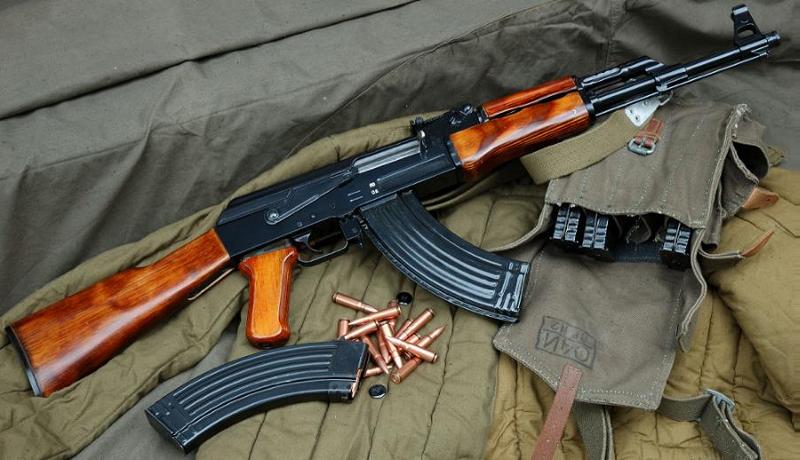
   The AK47, or Avtomat Kalashnikov Model 1947, was originally used by the Soviets and most participants of the Warsaw Pact. It is a select-fire, gas piston operated rifle chambered in 7.62x39mm. The AK47 is the most iconic weapon of all time for good reason. It is just plain bad ass! I prefer the AR/M16 platform but the AK is a very close second.
   The AK47, from here referred to as the AK, has plenty of great attributes but it's best of them is it's design. It is rock solid and is renowned for it's durability. If the 7.62x39 were the choice of the U.S. military the AK would be my platform of choice (it's an ammo availability in a SHTF situation thing). They can be thrown in the mud, filled with sand and shaken out, thrown form cliffs, you name it, the AK can take it and more. The sight system is nice but not the best. It is kind of heavy too, factory specs had them weighting in at 9.5lbs but they are more like a full 10lbs. One great thing about the AK is that it can be field stripped in under a minute without much effort. I can tell you factoids until I am blue int he face or you can find a way to try one out. If that isn't an option just follow this youtube link. There are tons of AK related videos there. Bunches of those are the useless AK vs AR crap. I am sick of the argument, they are both great weapons but useless without training and knowledge.
The black AK above is one of my home brew AK's
   In the U.S. we are allowed to own any gun we want, even the really cool auto and suppressed stuff if we get a tax stamp from the ATF. We can also build guns for personal use. I have built a few AK's, most recently I did a run of 7 as part of a group buy and group build. (Don't build just anyone a rifle, these were people I knew very well. Dad, brother, grand dad, close friend, and of course a few for me) I will try to dig up some photos of the process and put a step by step together for the readers. If you can't wait on that just head on over to AR15.com for more AK info than one man's brain can handle. A word of caution though: rebuilt rifles usually don't have serial numbers on their receivers and most police officers do not realize that if you can legally own a gun you can legally build a gun for yourself. Check you state laws before taking my word on it though. Also, AK prices are down right now and can be bought a good deals so it may not pay to build one. There is something cool about knowing that you built it yourself, it adds a little something extra to that whole "This is my rifle, There are many like it, but this one is mine..." thing.

Sunday, March 20, 2011

Choose your weapon!

  
This is one of the more fun sides to a zombie survival plan. Weapon choice isn't as cut and dry as one might think. Guns are ideal but need ammo. Blades are good but are only good for close range. Bows are great but arrows are limited and fragile. We can't forget about random items such as ball bats, fence posts, 2x4's, axes, etc.    Let us talk about blades first. You viable options are swords, katanas, machettes. Swords are generally heavy and fairly slow. Don't think you super beastly looking Lord of the Rings replica is going to hold up to the abuse of fighting of a zombie horde. Katanas are lightweight and fast for their size. There are alot of cheap replicas out there though. Replicas are not durable. Machetes are short but tough. I personally prefer the machete. There will be a post that focuses more on blades later.
   Bows and crossbows are good because they have reusable projectiles. An arrow can be used many times but does eventually fail. Crossbows are best, followed by compound bows, and I would just leave the ole' long bow at home. Once again, the details will come in another post.
   Guns make me happy. Assault rifles, hand guns, shotguns, light machine guns, bolt action rifles, and more can be the difference in living or becoming another zombie. Nothing short of explosives can take out zombies like a gun. Your gun selection is very important though. Taking a .50 BMG sniper rifle isn't going to do you much good against a zombie horde. Neither is your kids bb gun. I will break down the pros and cons of each type of gun in a series of class specific posts.
   And we come to the random items part. I am working on a list of various items that are readily available and can be good weapons. I will even teach how to make you own weapons. There isn't much that's more fun than that.
 

WEAPONS: The AR-15

   
   The AR-15 is my chosen rifle system in a survival situation.It is fast, comfortable, and fairly reliable. Many believe that it has reliability issues but that just stems from problems with the M16 during the Vietnam ear. Besides auto stuff is never as reliable and the semi guns. AR-15 rifles, carbines, etc are finally getting to be more affordable. I love how easy it is to change upper receivers and that essentially gives you a new gun but only one upper should be carried in a survival situation. I will take my standard 5.56 upper. My rifle, technically a carbine, is a Smith & Wesson MP15X.  When choosing an AR-15 there are a few things to consider:
  1. A 5.56mm chamber is preferred over the .223. You can shoot .223 and 5.56 ammo from a 5.56 barrel but you should not shoot 5.56 from a .223 barrel.
  2. Chromed lined barrels and chambers improve reliability and are easier to clean.
  3. Lightweight barrels are faster than heavy barrels. We are just trying to survive, not shooting in matches.
  4. Don't hang a bunch a "tacticool" stuff of of the rails. I have a vertical fore grip and a flashlight and that is all it is getting.
  5. Get a good sling system. 3-point is going to be best in a survival situation.
  6. Most AR-15 manufacturers built quality stuff. I don't think Colt is better than DPMS, or SW is any better than CMMG, etc. There are a few companies that make supreme parts, such as Noveske and Daniele Defense, but I don't think their stuff is worth the extra cash. To save money you can build them yourself too. That will save you about $200 usually.
   It is important that you know your rifle. Read the paperwork that came with it over and over again. Also, use AR15.com. You can learn more than you will ever need to know about the AR platform at that site.

   There will be plenty of more posts about the AR-15 in the future. It is one of my favorite topics! Later I will talk about optics, accessories, ammo, and more.

Monday, March 14, 2011

OK, so those first two posts didn't teach you much about zombie survival but what they did have a purpose. They showed how a zombie virus can affect living creatures. Now we get into the good stuff.

For the next few posts you can look forward to reading about the important stuff such as:
  • Creating a bug out bag
  • Choosing your weapons
  • General survival tips
  • The pro's and con's to getting on the move vs. holding up in one place
  • Weapons techniques
  • and more
Max Brooks wrote a book, The Zombie Survival Guide: Complete Protection from the Living Dead, that was published in 2003. It is a decent book but with some good advice but it has more entertainment value than actual zombie attack survival techniques. You can get it on amazon for just a few bucks.
I will compile a list of must reads on the topic of survival. If this thing gets bad we will still need to know how to survive after the zombies are gone. I don't think they will last but a few days anyways but I will save that for another post.