Showing posts with label CDC. Show all posts

Sunday, January 15, 2012

Drug Resistant TB Case Confirmed in Indiana


On January 13, 2012, The Journal Gazette of Fort Wayne, Indiana reported one confirmed case of drug resistant Tuberculosis in Allen County. A student of Anthis Career Center had been diagnosed as having active TB in December, 2011. As a result, 150 students in Fort Wayne Community Schools have been tested as a precaution. Another round of skin patch testing will be performed after eight weeks to confirm no additional cases.
From the Centers for Disease Control website:
TB is spread through the air from one person to another. The TB bacteria are put into the air when a person with active TB disease of the lungs or throat coughs, sneezes, speaks, or sings. People nearby may breathe in these bacteria and become infected.
TB is NOT spread by
  • shaking someone’s hand
  • sharing food or drink
  • touching bed linens or toilet seats
  • sharing toothbrushes
  • kissing
You can be exposed to tuberculosis and not develop symptoms. This is because your body is able to fight the bacteria and keep it from growing. A positive skin test may reveal “Latent TB Infection.” These individuals are not contagious. TB symptoms may develop later in life when the immune system is compromised. TB can make you sick and death may occur if left untreated.
From a preparedness standpoint, your best defense to the disease is to keep your immune system functioning normally. If you are not exercising, then find a plan and stick with it. Challenge yourself to eat a healthier diet. If you smoke, commit to quitting. Some people herald the use of supplements such as regular use Vitamin C and taking zinc at the beginnings of a cold. Getting adequate bed rest and drinking plenty of fluids daily is also prudent. These are simple changes to your daily regimen that may save your life. At the very least, you will feel better (and consequently, more prepared to face any scenario) and have the benefit of potentially adding years to your life.
Don’t forget to have on hand a supply of N95 or P100 masks. These are available in a variety of sizes and from multiple sellers on the internet as well as Amazon
PG
About The Author: MOTH (Mother Of The House) is the Co-founder and Editor-In-Chief of Radical Survivalism Webzine.

Friday, October 21, 2011

Not a thing of the past: TB outbreaks in Texas schools show disease still a threat

By Amanda Gardner
HealthDay Reporter
FRIDAY, Oct. 14 (HealthDay News) -- Outbreaks among young people in Texas of the old foe tuberculosis -- often mistakenly dismissed as a long-ago health menace now confined to the pages of a Charles Dickens novel -- show that the respiratory disease is still easily contracted and remains a potential threat to Americans, experts say.
"Tuberculosis has always been with us and probably always will be," said Dr. Len Horovitz, a pulmonary specialist with Lenox Hill Hospital in New York City.
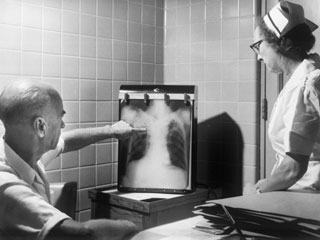
An X-ray of lungs taken after a positive TB test (© CDC)At least 100 people have tested positive for tuberculosis (TB) on skin tests in Ennis, Texas, about 40 miles south of Dallas, including several students at the local high school. The testing was done after a teacher was diagnosed with TB before the start of the school year.
And the University of North Texas in Denton -- about 70 miles away -- recommended that 27 people who had had contact with a student diagnosed with a suspected case of TB also be tested, according to local news reports.
A student at Denton High School also has suspected TB after transferring from Ennis High, although health authorities insist there is no link between the University of North Texas cases and the one at Denton High.
"TB is spread by the respiratory-droplet route, so coughing, talking, singing, breathing, even sitting in front of somebody in an airplane" can put a person at risk, Horovitz explained. "It's air-borne but it has to be in a certain range. It could be in the same room. It's very easily contracted."
While it's no longer the scourge of centuries past, about 11,000 cases of TB were reported last year in the United States, the lowest rate ever. California, Florida, New York and Texas together accounted for half of these cases, according to the U.S. Centers for Disease Control and Prevention.
"When looking at the populations hardest-hit by TB -- racial/ethnic minorities and foreign-born individuals -- both groups continue to be disproportionately affected despite declines," said Dr. Kenneth Castro, director of the CDC's Tuberculosis Elimination Program.
"TB rates for all racial/ethnic minorities are higher than those of whites -- seven times higher for Hispanics, eight times higher for blacks, and 25 times higher for Asians," he added. "Among foreign-born individuals, TB rates are 11 times higher than among those who are born in the U.S."
TB disease is caused by a bacterium called Mycobacterium tuberculosis which typically attacks the lungs. But the germ can attack any part of the body -- such as the kidneys, the spine, and the brain. And if it's not treated with the proper drugs, TB disease can be fatal, according to the CDC.
The highest risk for transmission is among people who live in the same household as well as people in college dorms, barracks and other close quarters, said Dr. Kenneth Bromberg, chairman of pediatrics and director of the Vaccine Research Center at the Brooklyn Hospital Center in New York City.
Children and teens in school settings are at an "intermediate risk," he said.
Encountering people on a bus, subway or airplane is a less common means of transmission, but it can happen.
Just because someone has a positive result on a TB skin test doesn't mean they're infectious or even sick, however. It simply means they've been exposed to the bacterium that causes the disease. These people have a 5 percent chance of becoming sick over their lifetime, Bromberg said.
And "a subset of people with positive skin tests could be infectious," he added.
But the germ is most often spread by people who have symptoms, such as a chronic cough or weight loss.
One recent concern has been the emergence of drug-resistant or even multi-drug resistant strains of TB. These cases are harder to treat. Antibiotics are the usual course of treatment for non-resistant TB.
Health experts divide infection with tuberculosis into two categories: latent TB infection and full-blown TB disease. The CDC estimates that more than 11.2 million people in the United States are living with latent TB infection.
People with latent infection have the germ in their bodies, but they don't feel sick and don't have symptoms because their immune systems are keeping the infection in check. The only sign of potential trouble is a positive reaction to the tuberculin skin test or special TB blood test. People with latent TB aren't infectious, they can't spread the disease and may never develop the disease. But, if the germ becomes active and multiplies, TB disease can result, according to the CDC.
TB disease, on the other hand, means the immune system can no longer keep the bacteria under control. Symptoms can include a bad cough that lasts three weeks or longer; chest pain; coughing up blood or sputum; weakness or fatigue; weight loss; lack of appetite; as well as chills, fever and night sweats, according to the CDC.
People with weakened immune systems -- especially those infected with HIV -- run a higher risk of TB infection than people with normal immune systems.
Currently, there are 10 drugs approved by the U.S. Food and Drug Administration to treat tuberculosis, including the first-line medicines isoniazid, rifampin, ethambutol and pyrazinamide.
More information
For more on tuberculosis, visit the American Lung Association

 Source:  http://www.wrcbtv.com/story/15694621/tb-outbreaks-in-texas-schools-show-disease-still-a-threat

The CDC did it again!

If you have been reading Zombie Splatter for very long you will remember a few months ago when I said that the "CDC Stole my platform." It looks like they are still using it. AT least I know using a zombie outbreak to teach preparedness is not only a good idea in my head.

Zombie Cover Banner
"CDC has a fun new way of teaching the importance of emergency preparedness. Our new graphic novel, "Preparedness 101: Zombie Pandemic" demonstrates the importance of being prepared in an entertaining way that people of all ages will enjoy. Readers follow Todd, Julie, and their dog Max as a strange new disease begins spreading, turning ordinary people into zombies. Stick around to the end for a surprising twist that will drive home the importance of being prepared for any emergency. Included in the novel is a Preparedness Checklist so that readers can get their family, workplace, or school ready before disaster strikes. Click on the images below to view the novella. Transcripts of each chapter are provided below each chapter thumbnail."


What Does The CDC Do? (Besides explode in the last episode of The Walking Dead, Season 1)

CDC safeguards our nation from major health threats.

Crisis Response
CDC’s Emergency Operations Center serves as a 24/7 central command for public health responses to emergencies like Hurricane Katrina, H1N1 and the Deepwater Horizon explosion.
Medical Stockpile  
CDC maintains a Strategic National Stockpile that distributes lifesaving vaccines, medicines and supplies following a public health crisis.
Bioterrorism Prevention
CDC’s Rapid Toxic Screen Test can screen human blood for traces of 150 toxic chemicals, including those most likely to be used by terrorists.
State Readiness
CDC provides essential funding for state and local health departments to develop emergency response plans and maintain around-the-clock disease detection and reporting.
Food Safety
CDC helped investigate more than 200 multi-state foodborne outbreaks in 2010, including E. coli and Salmonella.
Global Detection
CDC’s global disease detection network responded to 535 disease outbreaks and detected 51 new pathogens from 2006 to 2010.
Learn more about how CDC protects us all.

Any good survivalist will have the CDC's contact information handy:
  • Centers for Disease Control and Prevention
    1600 Clifton Rd
    Atlanta, GA 30333
  •   800-CDC-INFO      
    (800-232-4636)
    TTY: (888) 232-6348
    24 Hours/Every Day
  • cdcinfo@cdc.gov


Get The official CDCready App for you smart phone by scanning the QR code:


Thursday, October 20, 2011

Multistate Outbreak of Listeriosis Linked to Whole Cantaloupes from Jensen Farms, Colorado

I copied this directly from the CDC's site. Where was the media on this one?

Persons infected with the outbreak-associated strains of Listeria monocytogenes, by state*

Today's Highlights, October 18, 2011

  • As of 9am EDT on October 17, 2011, a total of 123 persons infected with any of the four outbreak-associated strains of Listeria monocytogenes have been reported to CDC from 26 states. Pennsylvania has reported their first case since the last CDC update.
  • Twenty-five deaths have been reported. In addition, one woman pregnant at the time of illness had a miscarriage.
  • Go to October 18, 2011 for a full report.
  • CDC recommends that consumers not eat whole or pre-cut Rocky Ford-brand cantaloupe from Jensen Farms. This is especially important for older adults, persons with weakened immune systems, and pregnant women.
  • Even if some of the cantaloupe has been eaten without becoming ill, dispose of the rest of the cantaloupe immediately. Listeria bacteria can grow in the cantaloupe at room and refrigerator temperatures.
  • Cantaloupes that are known to NOT have come from Jensen Farms are safe to eat. If consumers are uncertain about the source of a cantaloupe for purchase, they should ask the grocery store. A cantaloupe purchased from an unknown source should be discarded: "when in doubt, throw it out."
  • An early release of the MMWR on September 30, 2011 highlighted this outbreak. Go to Multistate Outbreak of Listeriosis Associated with Jensen Farms Cantaloupe — United States, August–September 2011 for a full report.
  • More information about listeriosis and recommendations to reduce the risk of getting listeriosis from food are available at CDC’s Listeriosis webpage.
  • For more information on food outbreaks, please visit CDC’s Multistate Foodborne Outbreaks page.