Showing posts with label FOOD. Show all posts

Sunday, January 26, 2014

Raised Bed Gardening is Cheap and Productive

June 7, 2011


Every time I open a plant catalog or see a television commercial for sale-priced $99 raised bed gardening kits, I cringe! You don't need to spend that kind of money to build your own four-by-four-foot bed or even a 20-foot-long one.
My husband builds mine. He buys two 1 x 8-inch cedar boards, which don't rot with age. They come in 8-foot lengths, which is perfect for 4 x 4-foot beds. Cut each plank in half, so that it is 4-feet long. Or, you can have a home improvement/lumber store make the cuts. Many places will do it for free.
Husband also buys a 3-foot length of a 1 x 1-inch pine stake; he cuts it into four pieces and uses them to nail the cedar boards to at corners for bracing. That's all!
how to build raised garden beds
Grouping together several raised beds makes a substantial vegetable garden that is easy to maintain, with no weeding and crops that mature fast
I place the boxes on cleared ground. We cut and roll up our turf, but many gardeners do not think it is necessary. The added 6 inches of soil will bury most of the grass and weeds beneath. After I situate the boxes (four or five grouped together makes a good sized garden), I put down three layers of newspaper to suppress errant weed or grass seeds that might sprout. Paper degrades fully within weeks and feeds the soil.
Another fast, cheap method of building raised beds is to use concrete construction blocks. They have a big bonus. Their holes can be filled with soil mix and planted with herbs or strawberries.
The extra gathered heat from concrete is perfect for Mediterranean-type herbs such as rosemary and lavender. Strawberry plants grow huge and fruit fast in the holes. Each block is 16 inches long by 8 inches high; I purchase mine at big box stores as find the price most reasonable. Beds of 13 feet or longer by 4 feet wide are cheaper to build using blocks than with cedar boards.
Cement construction blocks are a cheap method of building raised beds.
You will be planting seeds and transplants close, because the beds are smaller and the soil is richer. But, plants grown close together in raised beds mature faster, because they compete for nutrients and sunlight. Each plant senses the distance of others and adjusts its metabolism to compete. Several university studies have proven this competition syndrome by identifying how plants perceive others nearby using the green light spectrum.
This 4 x 4-foot bed is crowded with productive peppers, cucumbers, a tomato plant and insect-repelling flowers that are edible.
Raised Bed Soil Mix
The more organic matter there is in soil, the better. Soil microbes are fed, oxygen and water
readily reach roots and plants thrive. Here’s the recipe I’ve developed in the last decade that
works best for my garden.
For one 4 x 4-foot raised bed. (Multiply amounts to fill larger beds.)
2 bags (2-cubic-feet each) top soil
1 pail (3-cubic-feet) peat moss
1 bag (2 to 3-cubic feet) compost or composted cow manure
2-inch layer of shredded leaves or grass clipping.
If you use grass, make sure the clippings are not from a lawn that has been sprayed with herbicides or been fertilized with a food that contains granular herbicides to kill weeds. Both persist and will kill plants beds up to three years after the initial application.
Mix all materials with a hoe or cultivator and water well. Be sure to mulch well with organic Matter such as more leaves or clippings or straw.

Related Articles


Comment Form is loading comments...

Sunday, February 12, 2012

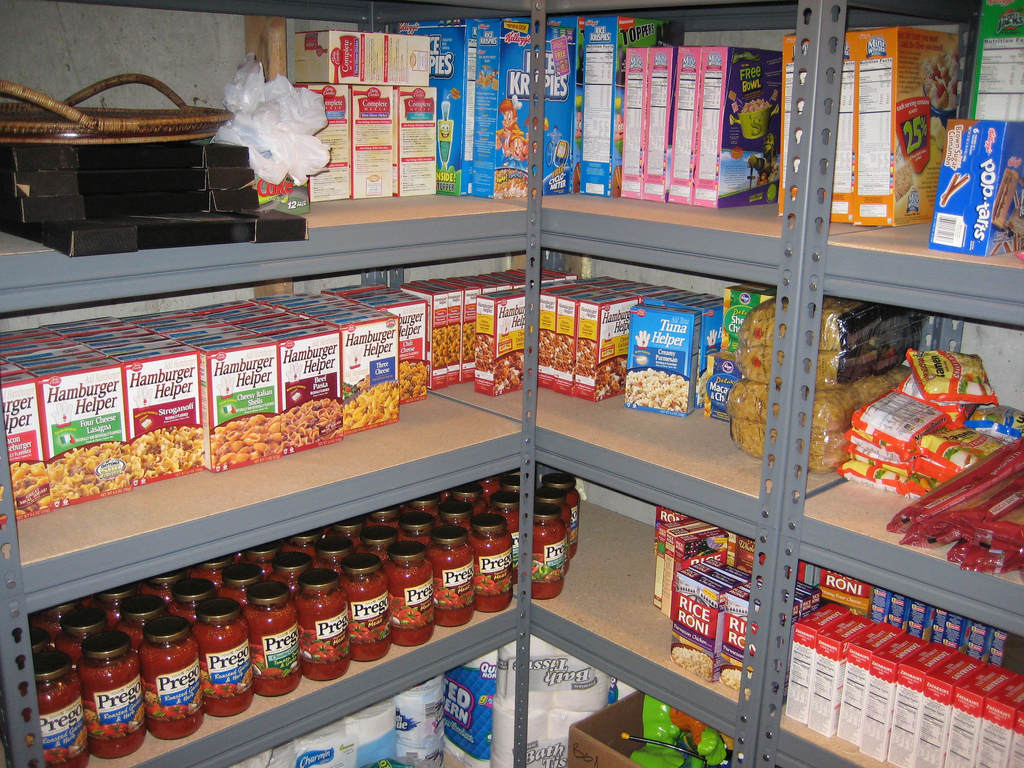
Building Your Food Stores Without Going Broke

Today I want to touch on the topic of food storage. Food and water storage needs to be a staple in any preppers lifestyle.  The general rule of thumb is that you need 25 lbs of grains like rice, wheat, corn, etc for each person per month you are prepping for. On that same scale you will need 5 lbs of dry beans. For example. if you are prepping for 3 months for a family of four you need 300 lbs or grains and 60 lbs of beans. You also need 1 gallon of water per each per for everyday. I will discuss water storage in another post. These are very general rules.. I'm sure you can imagine how expensive prepping can get if your buy all of your food at once. They is hope for those of thus that don't have a whole lot of extra cash laying around.
First of all, you NEED a 72 hour kit. Go ahead and shell out the cash to get that kit in place. If disaster strikes tomorrow, and it WILL for someone, you will be glad you did. Now that the 72 hour kit is in place just set it aside. That kit does not count toward your food stores. To start on your food stores you need to go look in your pantry. Make a list of what types of canned goods you keep at home. This list is going to be the basis of you food preps. Any time you go into the grocery store you are going to but a bag of dried beans and a bag of rice. Those are only a buck or two each. You are also going to buy three canned goods from you list. You are out $5-$7 and you have already increased your survivability by a few points. Be sure to mix up the types of beans and canned goods you buy so you have a little variety. Pretty simple, right?

You want to build up at least 3 months of food and water stores as quickly as you can but I suggest just taking inventory once monthly or bi-monthly. Progress will seem slow is you recalculate every time you add to your stores. Storing food preps is not a daunting task but it sure can seem to be sometimes. One way to save a lot of money is to get more bang for your buck. Use coupons! You will get more product for less money, in turn your food stores will grow exponentially faster. Buy one get one free offers on canned goods are like a guaranteed win lottery ticket to preppers.

Once you have built up your three months of food stores you should consider preserving your own food too. Canning is is great way to preserve some good food. Canned meat will be like gold when the SHTF! You can can almost anything including pre-made meals. I love to can molle chicken with green salsa. It goes great over all of that rice you have stored up.

Once you have a nice stockpile you can start using it as you own grocery store. If you take one can of green beans just be sure to replace it with two when you find that by one get one free offer. Doing this helps to rotate your stock as well. I just hope that any of you that are reading my blog don't think SHTF survival will be like a Man vs. Wild episode. You need to store food. Wildlife populations will quickly be depleted by the unprepared if we are cut off from the support of our society for only a few days. Primitive survival skills are great but we are not looking for rescue helicopters when the SHTF! Get you 72 hour kit and set it aside. Start on your preps and look at your progress in a month. You won't be so nervous come December of 2012. It is in the back of all of our minds........"What if they are right."


Wednesday, February 1, 2012

Monsanto files patent for new invention: the pig

Normally I would take anything from a green activist site with a grain of salt. I am not bashing environmentalists by any means. I consider myself one of sorts. In this case I totally believe the article below. Monsanto is getting out of hand folks...

____________________________________________________________

Monsanto files patent for new invention: the pig


Greenpeace researcher uncovers chilling patent plans


Feature story - August 2, 2005
It's official. Monsanto Corporation is out to own the world's food supply, the dangers of genetic engineering and reduced biodiversity notwithstanding, as they pig-headedly set about hog-tying farmers with their monopoly plans. We've discovered chilling new evidence of this in recent patents that seek to establish ownership rights over pigs and their offspring.


The Earth is flat, pigs were invented by Monsanto, and genetically modified organisms are safe. Right.
In the crop department,  Monsanto is well on their way to dictating what consumers will eat, what farmers will grow, and how much Monsanto will get paid for seeds. In some cases those seeds are designed not to reproduce sowable offspring. In others, a flock of lawyers stand ready to swoop down on farmers who illegally, or even unknowingly, end up with Monsanto's private property growing in their fields.
Oneway or another, Monsanto wants to make sure no food is grown that they don't own -- and the record shows they don't care if it's safe for the environment or not. Monsanto has aggressively set out to bulldoze environmental concerns about its genetically engineered (GE) seeds at every regulatory level.
So why stop in the field? Not content to own the pesticide and the herbicide and the crop, they've made a move on the barnyard by filing two patents which would make the corporate giant the sole owner of that famous Monsanto invention: the pig.
The Monsanto Pig (Patent pending)
The patent applications were published in February 2005 at the World Intellectual Property Organisation (WIPO) in Geneva. A Greenpeace researcher who monitors patent applications, Christoph Then, uncovered the fact that Monsanto is seeking patents not only on methods of breeding, but on actual breeding herds of pigs as well as the offspring that result.
"If these patents are granted, Monsanto can legally prevent breeders and farmers from breeding pigs whose characteristics are described in the patent claims, or force them to pay royalties," says Then. "It's a first step toward the same kind of corporate control of an animal line that Monsanto is aggressively pursuing with various grain and vegetable lines."

There are more than 160 countries and territories mentioned where the patent is sought including Europe, the Russian Federation, Asia (India, China, Philippines) America (USA, Brazil, Mexico), Australia and New Zealand. WIPO itself can only receive applications, not grant patents.  The applications are forwarded to regional patent offices.
The patents are based on simple procedures, but are incredibly broad in their claims.
In one application (WO 2005/015989 to be precise) Monsanto is describing very general methods of crossbreeding and selection, using artificial insemination and other breeding methods which are already in use. The main "invention" is nothing more than a particular combination of these elements designed to speed up the breeding cycle for selected traits, in order to make the animals more commercially profitable. (Monsanto chirps gleefully about lower fat content and higher nutritional value. But we've looked and we couldn't find any "Philanthropic altruism" line item in their annual reports, despite the fact that it's an omnipresent factor in their advertising.)
According to Then, "I couldn't believe this. I've been reviewing patents for 10 years and I had to read this three times.  Monsanto isn't just seeking a patent for the method, they are seeking a patent on the actual pigs which are bred from this method.  It's an astoundingly broad and dangerous claim."
Good breeding always shows
Take patent application WO 2005/017204. This refers to pigs in which a certain gene sequence related to faster growth is detected. This is a variation on a natural occurring sequence -- Monsanto didn't invent it.
It was first identified in mice and humans. Monsanto wants to use the detection of this gene sequence to screen pig populations, in order to find which animals are likely to produce more pork per pound of feed. (And that will be Monsanto Brand genetically engineered feed grown from Monsanto Brand genetically engineered seed raised in fields sprayed with Monsanto Brand Roundup Ready herbicide and doused with Monsanto Brand pesticides, of course).
But again, Monsanto wants to own not just the selection and breeding method, not just the information about the genetic indicators, but, if you pardon the expression, the whole hog.
  • Claim 16 asks for a patent on: "A pig offspring produced by a method ..."
  • Claim 17 asks for a patent on: "A pig herd having an increased frequency of a specific ...gene..."
  • Claim 23 asks for a patent on: "A pig population produced by the method..."
  • Claim 30 asks for a patent on: "A swine herd produced by a method..."
This means the pigs, their offspring, and the use of the genetic information for breeding will be entirely owned by Monsanto, Inc. and any replication or infringement of their patent by man or beast will mean royalties or jail for the offending swine.
Not pig fodder
When it comes to profits, pigs are big. Monsanto notes that "The economic impact of the industry in rural America is immense. Annual farm sales typically exceed US$ 11 billion, while the retail value of pork sold to consumers reaches US$ 38 billion each year."
At almost every level of food production, Monsanto is seeking a monopoly position.
The company once earned its money almost exclusively through agrochemicals. But in the last ten years they've spent about US$ 10 billion buying up seed producers and companies in other sectors of the agricultural business. Their last big acquisition was Seminis, the biggest producer of vegetable seeds in the world.
Monsanto holds extremely broad patents on seeds, most, but not all of them, related to Genetically Modified Organisms (GMOs). Monsanto has also claimed patent rights on such non-Monsanto inventions as traditionally bred wheat from India and soy plants from China. Many of these patents apply not only tot he use of seeds but all uses of the plants and harvest that result.
Orwellian: "The Earth is flat, pigs were invented by Monsanto, and GMOs are safe."
The big picture is chilling to anyone who mistrusts Monsanto's record disinterest for environmental safety.
And if you're not worried, you should be: central control of food supply has been a standard ingredient for social and political control throughout history. By creating a monopoly position, Monsanto can force dangerous experiments like the release of GMOs into the environment on an unwilling public. They can ensure that GMOs will be sold and consumed wherever they say they will.
By claiming global monopoly patent rights throughout the entire food chain, Monsanto seeks to make farmers and food producers, and ultimately consumers, entirely dependent and reliant on one single corporate entity for a basic human need. It's the same dependence that Russian peasants had on the Soviet Government following the Russian revolution. The same dependence that French peasants had on Feudal kings during the middle ages. But control of a significant proportion of the global food supply by a single corporation would be unprecedented in human history.
It's time to ensure that doesn't happen.
It's time for a global ban of patents on seeds and farm animals.
It's time to tell Monsanto we've had enough of this hogwash.

Help us stop patents on life

When you donate to Greenpeace, you keep researchers like Christoph at work as they keep an eye on corporations like Monsanto.


Click HERE for the original article.


Sunday, October 16, 2011

What to do when the grocery store shelves are empty

   When a disaster strikes the first resources to run out will be food and fuel. If you are properly prepared at home you wont need too much fuel unless the given disaster is an evacuation type situation. You typical "tin hat" survivalist will tell you that they will chose one of their 60 guns and head out hunting and foraging. While those skills are invaluable everyone else will have the same idea. Wildlife populations will be decimated at a pretty fast rate. As a survivalist you need to know how to produce you own food and with winter around the corner now is the time to start gearing up for spring. Every person on this plant needs to eat. Learn how to garden and start a simple garden so that you can hone your skills. It doesn't matter if you live on a 700 acre ranch of a small metropolitan apartment with a 4ft balcony; you can produce some, and in some cases all, of your own food. Start simple. Try growing some tomatoes in a window. If you fail figure out why you failed and correct it. It you succeed you should try some other vegetables.
   There are so many options when it comes to gardening methods that I cannot possibly hit them all in one post. This is going to be a small series of articles but to give credit where credit is due I want to mention Jack Spirko of The Survival Podcast. Jack's show is probably the best gardening resource available. I also learned alot from my parents since they always had a good sized garden when I was growing up. If you check out The Survival Podcast be sure to hit them up on facebook from the main TSP page and let them know that Zombie Splatter sent you. Maybe he will give me a shout out with his horde's of listeners listening. Anyways, I am rambling. Back to producing you own food. People also needs protein to survive. This can be a little tricky since alot of us, including myself, are forced to live within city ordinances. If you have land and do not have to worry about following the code laid down by "the man" you need to at least have a few chickens running around. Free egg production is just one of the countless number of benefits chickens can bring to your efforts. I will have to do and entire post on chickens. Rabbits are also great since their meat is great for you and they reproduce very rapidly.
Ok, I want to start a small garden. What should I do first?
   First you need to decided what you want to grow. But before you can do that you need to know what hardiness zone your are in. Look at the map to figure it out:
Now that you know what you want to grow need to decide if you want a traditional (tilled up rows) garden, if you want a container garden, a raised bed garden, or if you want to do something really cool like aquaponics. I will discuss each one of these in separate individual posts. Stay tuned to ZS for the coming articles because when the zombies have you trapped behind you barricades you will need to eat some of the rabbits and beans right out of your back yard. I am making a series out of this.

Sunday, August 21, 2011

Building Your Food Bank Without Breaking The Bank

Any serious survivalist knows that food stockpiles are a key factor in your survivability. Primitive skills, the ability to create, grow, and kill your own food is great and the more you know the better. Stockpiles allow you to sustain yourself and your family for longer without struggling to replenish your supplies. Building a personal food bank can be very expensive, especially in a economy that only allows most people to buy what they need on a day to day basis. There is hope.

Couponing seems like something soccer moms should be doing while the kids are at school but it is not limited to them. We survivalists can greatly benefit from couponing and if we do it right our stockpiles can be built for next to nothing if not free. TLC's show Extreme Couponing shows the rare cases of extreme saving using coupons. It seems unreal and it basically is unrealistic unless you want to put in 40+ hours a week to cutting coupons and strategizing your shopping trips. This is where time becomes your friend. Use coupons to ass to your food bank a little at a time.

I found a great website to get you started. Couponing101.com has all of the information you need to know to begin couponing your way to a room full of food. The following was pulled directly from that site:


A Beginner’s Guide to Couponing

by Stephanie on January 6, 2009
Are you visiting after watching TLC’s “Extreme Couponing”? Please read this post first: Realistic Couponing. Be sure to sign up for FREE Email Updates so you never a miss a deal, freebie, or coupon!
Couponing 101: A Beginner’s Guide to Couponing

Get some coupons!
  • The Sunday newspaper is a great source of coupons. Buy the newspaper with the largest circulation in order to get the best coupons. You can sometimes get them cheaper by buying a double pack. I find that a good rule of thumb is to purchase one newspaper per family member.
  • Ask your friends and family for coupons. If they get a newspaper but usually throw out the coupons then they’ll probably be happy to give them to you.
  • Peruse the Internet. There are many great online printable coupons to be found! You can find a list of Internet printable sites here!
  • Use a clipping service. If there is a great coupon that you would like to have multiples of then you might consider ordering the coupons from a clipping service like The Coupon Clippers.
  • Check the store. There are many varieties of coupons that you can find in the store. See a list here.
Organize your coupons!
  • Envelopes. You can start by clipping and putting them all in an envelope or check file. But, once you’ve been couponing for a few weeks you will need something bigger.
  • File by insert. With this method you just file your inserts by date in a box and use an online coupon database to find the coupon you need. This method doesn’t require much work but you might miss out on unadvertised deals by not having all of your coupons with you at the store.
  • Coupon Binder. With this method you would clip all of your coupons and file them in baseball card holders in a three-ring binder. With this method you can carry your binder to the store and have all your coupons with you while you shop. You can see my coupon binder here!
Know your store’s coupon policy!
  • Loyalty Cards. If your store offers a loyalty card then make sure to get one. Some stores only give the sale prices to card-holders. Loyalty cards are Free!
  • Double/Triple coupons. Double/triple coupons is when the store will take your 50¢ coupon and double it making it $1. This is done automatically at the register, you do not have to do anything to take part in this promotion. First, find out if your store doubles/triples coupons. If they do then find out the maximum double/triple value and how many they will double/triple. My Albertson’s will triple up to 35¢ and double up to 50¢. That means my coupons that are 35¢ and under will triple and 50¢ and under coupons will double. So, at Albertson’s my 50¢ coupon is actually worth $1. And they will only double/triple the first four like coupons. So, if I have 10 coupons for 50¢ off of shampoo, only the first four will double.
  • Stacking coupons. Some stores will allow you to use one store coupon (the discount is provided by the store) and one manufacturer coupon (the discount is provided by the manufacturer) per item.
  • Internet coupons. Find out if your store accepts Internet coupons.
  • Competitor coupons. Some stores will accept competitors coupons.
  • Expired coupons. Some stores will accept expired coupons!
Make a plan!
  • Weekly Ads. Read the weekly store ads to see what is on sale and which stores have the best prices on the items you need. If you don’t get the weekly ads delivered you can usually view them on the store’s website.
  • Coupon Matchups. See if you can match coupons to the sale items to get an even better deal! Some websites do this for you. Couponing 101 provides weekly coupon matchups for CVS, Walgreens, Albertson’s, Brookshire’s, and Kroger.
  • Pricematch. Some stores, like Walmart, will pricematch. This means that if grapes are on sale for 99¢/lb at Kroger, you can take the ad to Walmart and at checkout tell the cashier that you would like to pricematch the grapes. Show them the ad and they will sell you the grapes for 99¢/lb versus their higher price.
  • Make a List! Don’t go to the store without a list. Lists remind you what you came for and keep you from buying items you don’t need.
  • Rainchecks. If your store is out of the sale item, get a raincheck! Go to customer service and ask for a raincheck for the item you wanted. They will fill out a piece of paper with the item details and price. Then you can come back another day (usually no more than 30 days) and buy that item at the sale price by giving the cashier the raincheck. This also gives you more time to gather coupons for the item! You can still use a coupon if you are using a raincheck.
Don’t be fooled!
  • 10/$10 promotions. You do not have to buy 10 items to get the $1 price! The only exception to this rule is if the ad states that you must! Those times are rare and are usually for items that are buy x get y free, final price 2/$5, etc.
  • Rock-bottom prices. Don’t go out and use your coupon immediately! If you use that 25¢ off toilet paper right away when it’s not on sale you aren’t reaching your saving potential! Wait until toilet paper goes on sale for $1 then use the coupon. If your store triples coupons then you could get the toilet paper for only 25¢! Matching sales with coupons is getting a great price. Combining sales plus coupons plus another promotion (rebates, double coupons, store coupons) is getting the best price!
  • “One per Purchase.” I’ve heard this so many times! Most coupons say “one coupon per purchase” somewhere in the fine print. Cashiers will try to tell you that that means you can only use one coupon per transaction/day. This is NOT true! One per purchase means that you can only use one coupon per item purchased! So if you are buying 10 items and have 10 coupons then you can use them all!
  • Leave the kids at home! Shopping with kids will distract you and cause you to buy items not on your list!
  • Make a Pricebook. Start paying attention to prices and keep a list of items you regularly buy with the best and regular prices for those items. This will help you when you see that canned veggies are on “sale” for 10/$10 but the regular price is actually 99¢!
  • Limits. Stores will sometimes put limits on the item to make you think it’s a great price! If cereal is just on sale 2/$4 you might not even notice it. But if it’s on sale 2/$4, limit 2! then you will likely think it’s a great price since they had to put a limit on it!
  • Shop early. If you have couponers in your area then it’s best to get to the store as early in the sale as you can!
  • Bigger is better.” The cost per unit of the bigger box of cereal may be less than the smaller one but with coupons and sales the smaller box is likely a better deal.
  • Watch the cashier. When checking out pay close attention to the price screen to make sure everything rings up at the correct price. Also, make sure that the cashier scans all of your coupons. Coupons sometimes stick together or get dropped or the cashier will scan the coupon but not realize that it didn’t go through. Kindly point out that they missed one and they will correct it.
  • Check your receipt. BEFORE leaving the store look over your receipt to make sure everything rang up correctly and all of your coupons were scanned. If there is a problem take it to customer service immediately so they can fix it. If you leave the store and come back at another time then it might not be fixable. If the cashier missed a coupon and you notice right away it’s easy to see the mistake. But, if you come back later after several other coupons have been added to the cashier’s stack or the stack is gone then there is no way to prove that they missed a coupon.
Build your stockpile!
  • Start slowly. Don’t buy a ton of everything as soon as you get started or you will blow your budget! A stockpile takes time. Set aside a part of your weekly grocery money for stockpiling and do what you can with what you have.
  • Buy for the future. If an item goes on sale for a great price (or free!) then buy more than you need for just the week. Typically sales go in 12 week cycles so you only need to buy enough for 12 weeks. So, if you eat 1 box of cereal per week then when you find cereal at a rock-bottom price then you should buy 12 boxes. This way you have cheap cereal that will last you until you can buy it at a rock-bottom price again.
  • Know how much you use. Start paying attention to how many bottles of shampoo, packs of diapers, boxes of cereal, etc. you use. This will help you to have a better idea of how much you should buy and to not go overboard! If you only eat 1 box of cereal a month then there is really no need to buy more than a few boxes or they will just go to waste.
  • Donate it. Every couponer will eventually go overboard and buy too much of something. If there is no way you will use it before it expires then consider donating the item to a shelter or food pantry.


Sunday, August 7, 2011

FOOD: Surviving on Bugs

Most of us cringe at the idea of eating insects and other types of bugs. Something in our mind just says, "oh, hell no!" Yet, insects are in fact extremely rich in protein and fat and many cultures eat bugs on a daily basis. Bugs are very easy to find in all seasons other than winter. In a survival situation bugs must be considered as a daily staple in you protein supply. I have never eaten bugs so I can't tell you what they taste like from personal experience. I have heard that most of them taste the same when cooked and that they have a nutty taste when toasted. In my opinion, cooked bugs are the only edible bugs. Some bugs must be cooked in order to get rid of toxins. Unless you know exactly what toxins each species carries you need to cook insects before eating them.


The easiest way to cook bugs in a survival situation is toasting them in a camp fire. You can place the insects on a flat rock and place it in the edge of your fire, by doing this you have made a cooking stone. It also may be helpful to place another rock behind your cooking stone which helps to reflect the heat. The cooking stone will heat up and begin to toast the bugs without burning them like a direct flame would. Burning bugs will breakdown much of the proteins and fats which is the opposite of what you want.


wild polk salad
A survival stew may be an easier way to wrap your head around eating bugs. I will write a more extensive post on survival stew another day but a crash course will do for now. A survival stew is simply a stew made from what ever edibles you can find. For example, during August here in east Tennessee, polk salad is abundant and tasty but it is toxic when it matures and the root can be deadly. A parboiled young plant is perfectly edible. I could prepare my polk salad and add some crickets,  grasshoppers, and other bugs to it. If I boiled all of that to together for a few minutes and then brought it to a simmer (remember that cooking stone) for a little while longer I would have myself a nutritious survival stew. I could also add some black berries to make it sweet.


Back to bugs, avoid bugs with bright colors and hairy bodies. These are usually signs of danger. Worms are very edible but avoid grubs unless you know exactly what type it is because some grubs are toxic.  Also avoid bugs from dead animals an manure. And like I said earlier, cook all bugs. This adds a safety point to eating insects. Anyone with a survival mindset needs to learn their local species of plants, bugs, animals, and fungi. It would be beneficial to know everything that you can and cannot eat from the wild in a survival situation.


Be sure to connect with Zombie Splatter on Facebook and Twitter with the buttons at the top right of this page.


Saturday, April 9, 2011

FOOD: Possum, An Unlikely Food Source

ATTN: If you prepare properly your meals won't come to this.

   Have you ever eaten possum? I surely have not. I find them to be disgusting creatures and they make good targets. I have a hard time wrapping my mind around chewing that filthy creature but this is a survival blog and the post must go on. I had to do some research before putting this together. I wanted to be sure that eating them is safe. It is safe as long as they are thoroughly cooked.
   Possums have a gestation period of 12-18 days depending on what type the given possum is. That means the reproduce very fast. Anything that is safe, easy to obtain, and quickly reproduces cannot be over looked as a food source in a survival situation. Possums are all of those things.  My research tells me that the meat is very light and tender ad that the fat does not have a odor. I also learned that they are not very "gamey" tasting is killed quickly. Adrenaline is what adds that wild or "gamey" tastes to game.
   Possum does not skin very easily without some help. In order to clean it it should be gutted. Boiling is the best way to remove the hair. You pluck at the hair while it is boiling and when it comes out easily the hair is ready to scrape off. From there you can skin it and get the meat.
   If you have eaten possum of try it you MUST tell me about it! I am curious and applaud anyone with the kahonays to try it. Use facebook to tell me about it.

   Help us spread the word. I am hoping to start a forum for the Zombie Splatter followers as soon as we get 100 followers on facebook. Tell your friends!
 

Monday, April 4, 2011

Genetically Modified Cows Produce HUMAN Breast Milk!

   I heard about this today on Jack Spirko's The Survival Podcast. I do my best not to touch Mr. Spirko's topics to keep from regurgitation his original information. We like to use our own original content here on Zombie Splatter! Nevertheless, occasionally we will hit the same topics because we both deal with the topic of survival. I listen to The Survival Podcast almost everyday and some information is bound to bleed over; Jack Spirko is just good at what he does and I guess my occasional reference just proves that I am learning from listening to his show. (That has to be a frikin run-on sentence.....oh well) If you are a survivalist and/or prepper and you are not listening to Mr. Spirko's show I urge you to follow the link above and listen to the man for one week. You won;t be dissapointed and I am willing to bet you will keep listening to him.
   Anyways, to the main topic: Cows producing human like breast milk. I am going to copy the article to this post but in order to give Rebecca Boyle, the writer, credit HERE IS THE LINK TO THE ACTUAL ARTICLE. Ok, now read this and tell me you son;t see a problem here:

Genetically Modified Cows Produce Milk Akin To Human Milk

By Rebecca Boyle Posted 04.04.2011 at 1:01 pm

In a potential new step for genetically modified food, babies could someday drink human-like milk derived from herds of genetically modified dairy cows, which scientists say could supplement breast milk and replace baby formula.
Scientists have created 300 cows that produce milk with some of the properties of human breast milk, including lysozyme, which fights bacteria and improves infants’ immune systems in their first few days of life.

Researchers in China introduced genes that express human lysozyme (also called HLZ) and other human proteins into Holstein cattle embryos, and implanted the embryos into surrogate cows. When the GM cows started lactating, their milk contained HLZ and two other proteins.
Using a new purification process, the researchers were apparently able to make the milk taste more human — they increased its fat content and changed the amounts of milk solids, according to the Telegraph.
Human breast milk contains all the nutrients an infant needs, but cow milk is not as readily digested or absorbed. Making cow milk more human could give dairy products a nutritional boost, according to Ning Li, director of the State Key Laboratories for AgroBiotechnology at the China Agricultural University, and lead author of the study.

“Despite the benefits that HLZ provides to breast-fed infants, mothers do not always desire to lactate and sometimes situations prevent lactation; therefore, the development of alternate sources of HLZ would be beneficial to infant health,” the authors write.
The researchers believe human milk from cows could be a better breast milk alternative than baby formula.
Ling and collaborators at the Beijing GenProtein Biotechnology Company took samples from regular cows and GM cows for six months, and found no significant differences in the amount of fat, protein, lactose, and milk solids in the two types of milk. The cows also looked and acted like regular, non-GM cows, they said.
The authors tested the protein expression at pasteurization temperatures, ensuring it would pass muster with the U.S. Food and Drug Administration and other authorities. They hope genetically modified dairy products could someday be sold in supermarkets.
“The modified bovine milk is a possible substitute for human milk,” they wrote.
The study was published March 16 in the journal PLoS One.

  What the article is saying is that some scientists who probably never think about the totality f the consequences of their projects used a virus to alter the genetic sequence in cows. That made the cows into GMO's, or genetically modified organisms. The genetic modification made the cows produce milk that as very similar to human breast milk. GMO's have already proven to be a terrible idea in our vegetables so I want to know what makes these scientists think that I would want to pump my infant full of milk from a genetically modified cow. It is just not natural. Nature has been doing it right for thousands of years. Why change it now?